
What it is
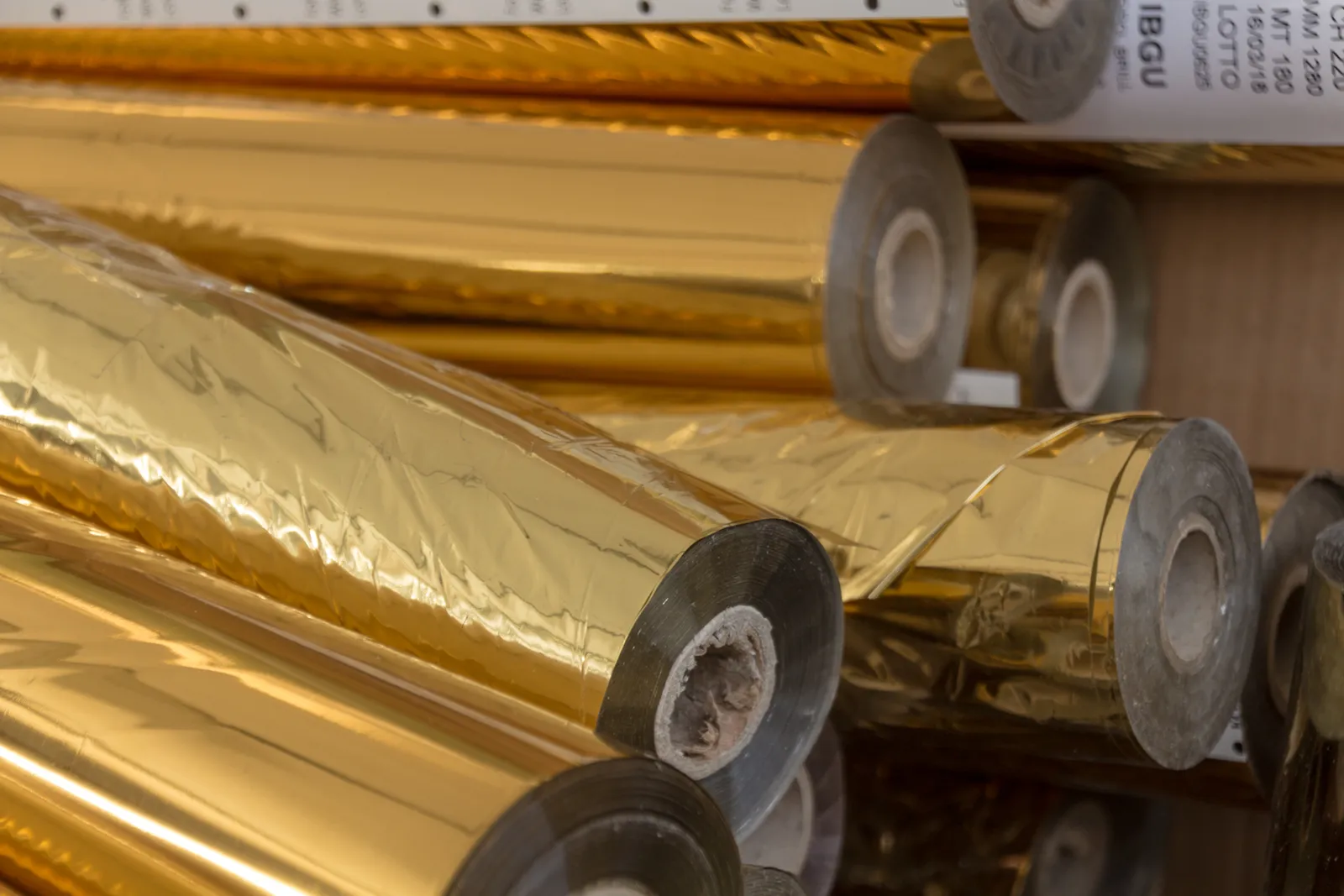
Hot foil stamping does not lay down ink: it transfers a film. The foil is a ribbon made of several layers carried on a polyester backing: a release layer, a coloured or protective lacquer, an aluminium metallised layer and, underneath, a heat-activated adhesive. A die engraved with the artwork is mounted on a heated platen and pressed against the sheet with the foil in between. The heat melts the release layer and activates the adhesive: the portion of film under the die leaves the carrier and stays on the paper, in exactly the engraved shape. The ribbon advances, the spent section winds up, the next sheet comes in.
The quality of the result depends on three variables that are set together: temperature, pressure and dwell time. The die is the bespoke part: it is engraved in magnesium, brass or steel according to the detail required and the length of the print run, because the materials wear and hold heat differently. The pressure also leaves a physical mark: the metal sinks slightly into the fibres, so the foil is never perfectly flush with the paper. If the artwork also has to stand proud, the same pass can carry a female counter-die and become foil stamping with embossing. There is also cold foil, which works the other way round: the adhesive is printed in line as if it were a colour, the film is bonded on top of it and no die is needed.
How to prepare the file
- A dedicated spot colour channel, named explicitly (GOLD FOIL, for example), at 100% and set to overprint: the channel is there to engrave the die, and must not knock out the artwork beneath it.
- Closed vector paths only. Foil is an on-or-off signal: no gradients, no transparency, no greyscale images. Screened foil tints do exist, but they are a deliberate decision taken up front, not something to be discovered on press.
- Fine rules and small type are the real limit of the process: below a certain size the foil fills in or frays. The minimum weight depends on the die and on the paper, so it is to be agreed at prepress stage.
- If the foil has to sit inside a printed outline, the register between the two passes is not perfect. It is better to design an element that stands on its own, or to allow for a deliberate overlap or gap: the amount is to be agreed at prepress stage.
- The foil is kept clear of creases, cuts and, above all, glue flaps, and a presentation PDF is attached showing at a glance what is foil and what is print.
What can go wrong
- On very rough papers, on open-surfaced through-dyed papers and on embossed substrates the foil rests only on the peaks and leaves micro-voids: the solid looks pitted. On these materials a softer foil is chosen, or the area of the artwork is reduced.
- Large solid areas are the riskiest request: air gets trapped, coverage becomes uneven and adhesion drops. A broken, lined or lightened design performs far better than a solid rectangle.
- Foil does not take glue and does not fold well: on a glue flap the carton will not hold, across a crease it cracks. It is also a difficult surface to print over, so as a rule it comes after printing, not before.
Frequently asked questions
- What is the difference between hot foil and cold foil?
- Hot foil uses an engraved die and heat, and it is a pass of its own. Cold foil uses an adhesive printed in line and needs no die. The first gives a fuller metal and holds fine detail better; the second fits into the printing sequence and allows colours to be printed over the metal.
- Can anything be printed over foil?
- Over hot foil it is difficult: the surface is closed and the ink struggles to anchor. If the intended effect is a colour that looks metallic, cold foil with the four-colour process printed on top is usually the better route. The choice belongs at prepress stage, not once the press is running.
- Is a new die needed for every design?
- Yes: the die is engraved to that specific shape. If the design changes, the die changes. If instead the design stays identical from one print run to the next, the same die is reused for as long as the engraving holds up, which depends on the material it was made from.