
What it is
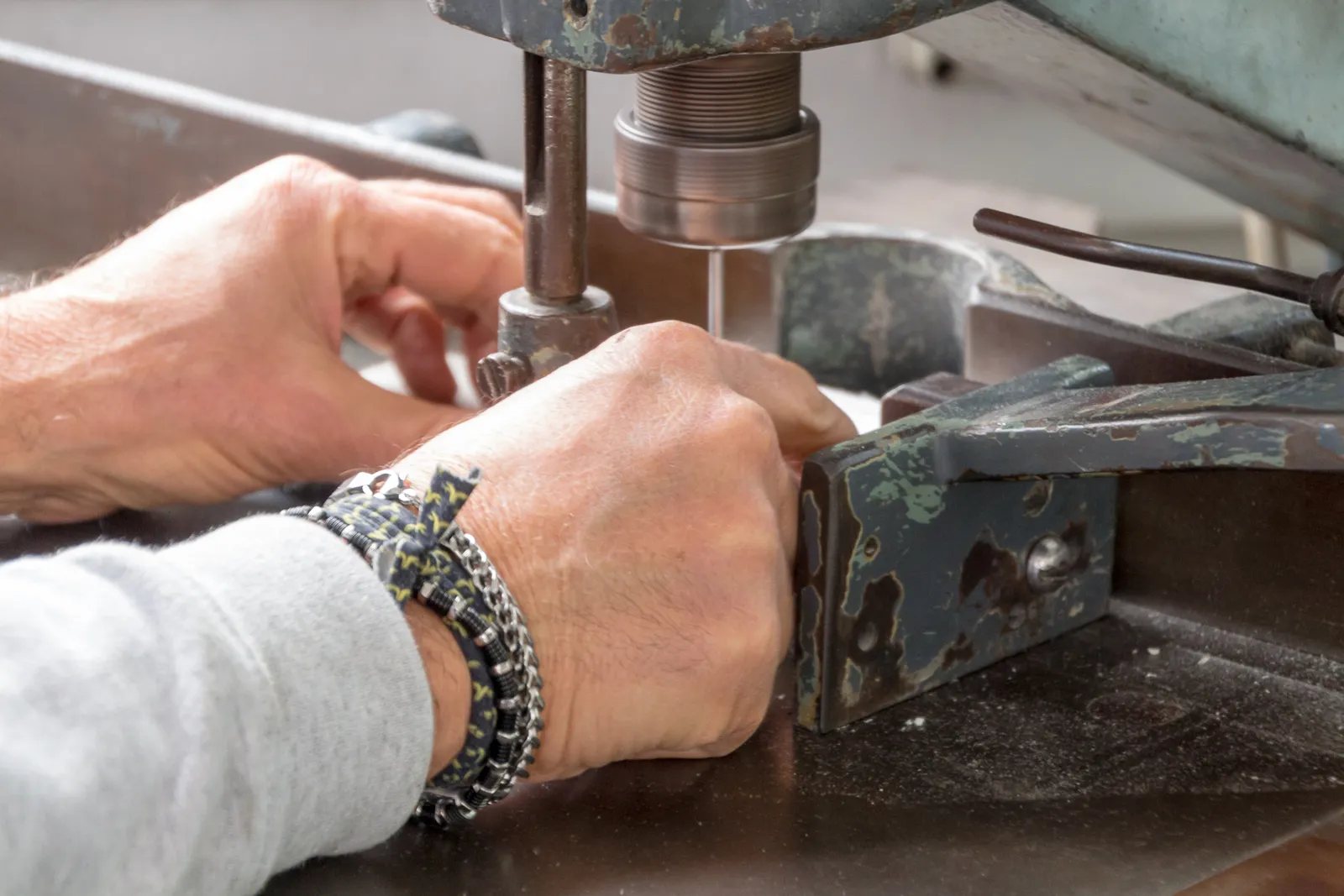
Blind embossing is the only finish that adds nothing to the sheet: it changes the shape of the paper. Two mating parts are needed, a male die engraved in metal and a female counter-die that is its negative. The sheet passes between them and the platen closes. Under pressure, and often with the help of heat, the paper fibres stretch and take on the shape of the engraving. The deformation is permanent because, beyond a certain point, the fibres do not spring back. When the design stands towards the viewer it is embossing; when it sinks, it is debossing.
The male die is engraved in brass, steel or magnesium depending on the detail and the print run; the counter-die can be a cured resin built on the male die itself or a second engraved metal, and much of the cleanliness of the edge depends on it. The engraving does not have to be single-level: several stacked planes are possible, bevelled edges at different angles, background textures, or micro-embossing for very fine detail. The physical constraint is always the same: the achievable depth depends on how far the paper will stretch, and therefore on the grammage, composition and moisture content of the substrate. And since the sheet deforms right through, the counter-form always appears on the reverse.

How to prepare the file
- A dedicated spot channel (EMBOSS, for example), vector, at 100% and set to overprint: it is there to engrave the male die and must not interfere with the printing separations.
- An explicit indication, on a separate layer or as a note on the presentation PDF, of which areas are to be raised and which recessed, and, for multi-level embossing, the order of the planes from highest to lowest.
- Closed shapes, with no detail below the minimum engravable weight: rules that are too fine do not survive the pressure and the fine negative details close up. The threshold depends on the die and on the paper, so it is to be agreed at prepress stage.
- The embossing is kept away from creases, cuts and the edges of the piece: close to a fold the deformation does not have enough material to work with. The safe distance depends on the board and is defined at prepress stage.
- If the embossing has to coincide with a printed element, the join is drawn with a tolerance: fine rules where print and embossing meet are best avoided, because the slightest register deviation makes them visible.
What can go wrong
- The counter-form on the reverse is not a defect, it is physics. On a single-ply board, one not duplexed to a second layer, the embossing shows through on the other side: if the reverse is a visible face, that has to be decided at the design stage, not discovered in production.
- Gloss coated papers and very stiff boards are the worst candidates: the edge of the embossing whitens, the coating cracks and the achievable depth is low. Long-fibre papers, uncoated or through-dyed, hold up far better.
- Embossing that crosses a crease or runs into a glue flap creates two problems at once: the fold no longer comes back straight and the glue finds no regular surface to hold on to.
Frequently asked questions
- What is the difference between embossing and pattern embossing?
- Embossing works on a defined design, with a male die engraved for the purpose and a counter-die that mates with it. Pattern embossing is a continuous texture impressed across the whole surface, usually with a cylinder. The first is a graphic element, the second is a property of the material.
- Does the embossing show on the back of the sheet?
- Yes, always: it is the same paper that has moved. If the reverse has to stay clean, the work is done on a duplexed substrate or on a rigid structure, or a shallow debossing is chosen instead. It is a decision to take before the male die is engraved.
- Can embossing be done over lamination?
- As a rule yes, and it is in fact the usual order: film first, then the deformation. The film follows the paper. The type of lamination and the depth required do have to be checked together, though, because a stiff film over a deep emboss can mark or lift at the edges.