
What it is
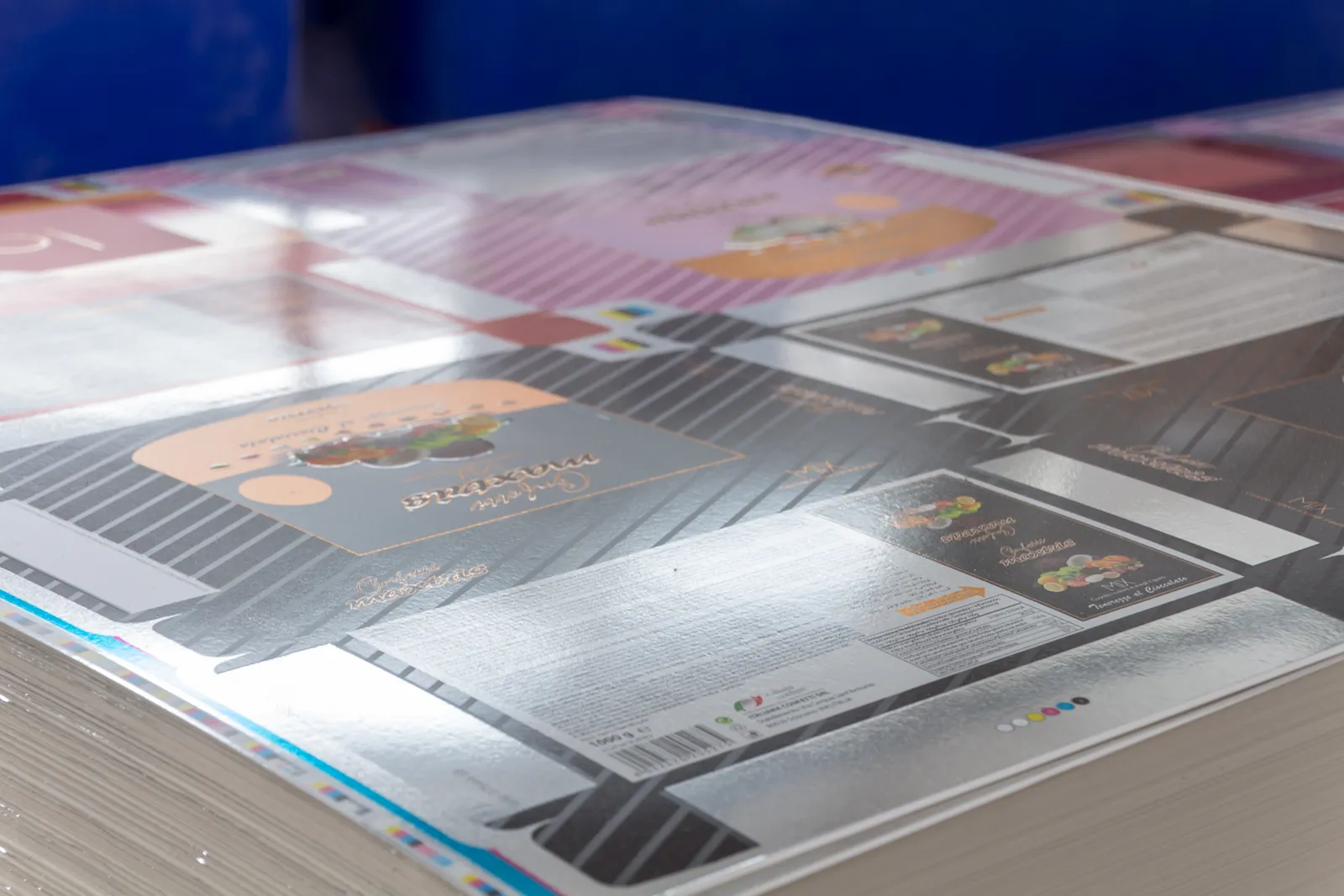
Drip-off is a chemical effect, not a mechanical one. Two varnishes that do not get on are used on press: first, from a printing unit, an oil-based (oleoresinous) base varnish is laid down, mounted on a plate as if it were a colour and therefore drawn exactly as wanted; then, from the last coating unit, the whole sheet is covered with a second varnish of a different nature. Where it meets the base, the second varnish does not wet the surface: it pulls back, gathers into micro-droplets and leaves a matt, slightly rough area. That is exactly where the name comes from. Where there is no base, the varnish flows out and stays glossy.
The practical advantage is that the contrast is drawn by an ordinary printing plate, not by a shaped varnish form: the register between effect and image is therefore the same register as the colours, which is the best obtainable, and the whole thing is resolved in a single pass on press. In exchange, the effect is subtler than a screen-printed varnish in register: there is a clear contrast of gloss and a difference that can be felt, but no real thickness. The variants play on the same principle, reversing which area stays glossy or using base varnishes that accentuate the roughness.

How to prepare the file
- A spot channel is needed for the base varnish, on the same logic as a flat colour: it is that plate which draws the effect. It must be stated unambiguously whether the channel represents the matt area or the glossy one.
- The base varnish occupies a printing unit on press: it is declared at prepress stage, because it determines how many colours remain available for the artwork.
- The contrast is designed on legible shapes. Very small details and hairline rules do not return the difference in gloss: the effect reads on areas, not on strands of hair.
- It is not a way to simulate embossing: drip-off changes the gloss and the feel of the finish, it does not add thickness. If volume is needed, the route is a different one.
- A presentation PDF stating what is matt and what is glossy is always attached, because on screen the effect does not exist.
What can go wrong
- The effect is fainter than a varnish in register. If the customer expects the thick, glassy layer over the image, drip-off will disappoint: it is a contrast of surface, not a deposit.
- The result depends heavily on the paper. On coated stocks the contrast is sharp; on absorbent, uncoated or recycled papers the base sinks in and the difference flattens out until it disappears. A trial on the real paper is not optional.
- It is an already finished surface: hot foil over drip-off struggles to adhere, and laminating afterwards contradicts the very point of the process. Finishes that have to coexist are planned in advance.
Frequently asked questions
- Why choose drip-off instead of spot UV varnish?
- For three reasons: the register, because the effect is drawn by a printing plate; the single pass, because no downstream operation is needed; and the material, because no plastic film is added. What is given up is thickness and a marked tactile contrast.
- Does it show on a digital colour proof?
- No. A colour proof reproduces colour, not gloss. Judging drip-off calls for a sample printed on the chosen paper: it is the only way to know how much contrast that substrate will return.
- Does the piece stay recyclable?
- Drip-off uses varnishes and bonds no plastic film, so in terms of impact on the paper stream it behaves like varnishing, not like lamination. The formal assessment on the individual product still has to be made case by case, according to material and end use.