
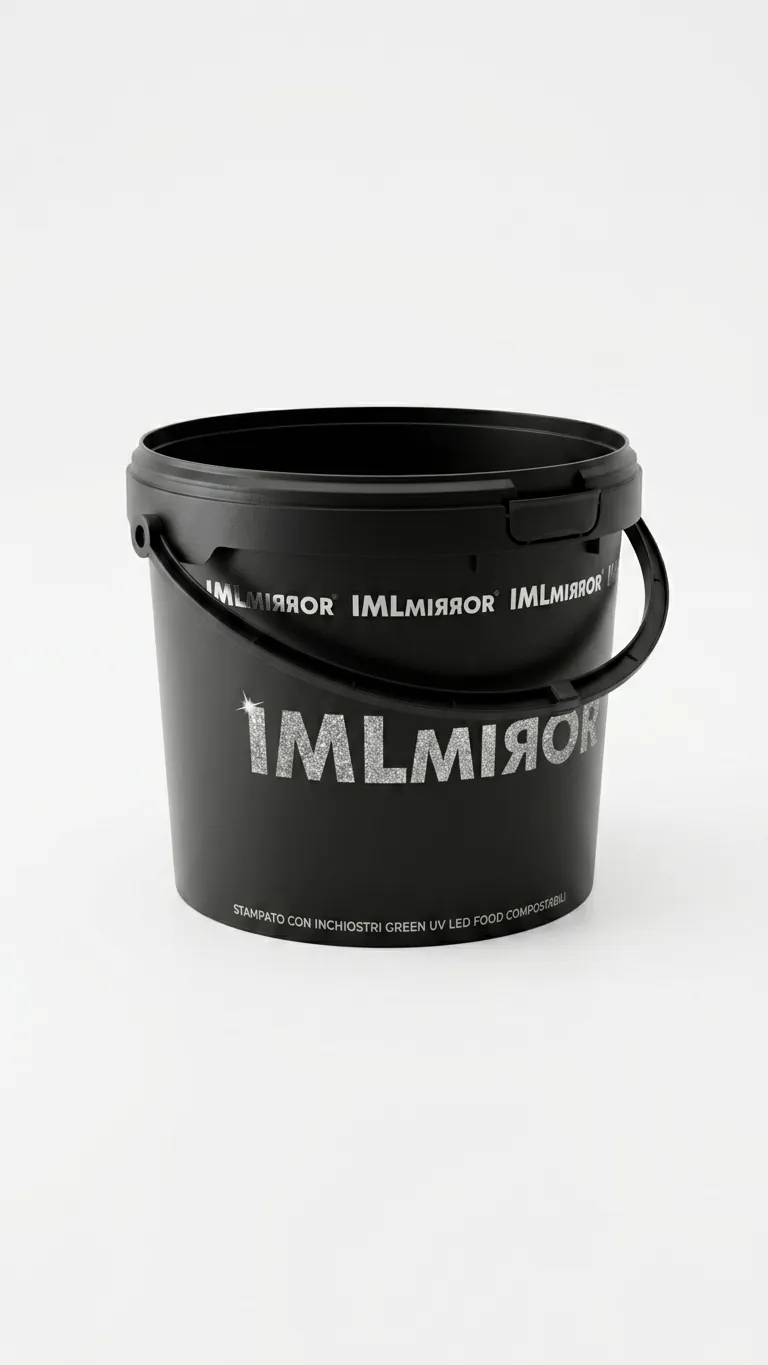
What it is
IML – In-Mould Labelling (in-mould labelling) is not a labelling operation: it is a decoration that takes place inside the mould. The label is printed on plastic film, die-cut to the exact shape of the container wall and loaded into an automatic magazine. Before each cycle a robot picks it up, carries it into the open cavity of the mould and holds it against the wall, usually with an electrostatic charge or with vacuum. The mould then closes and the molten polymer enters: heat and pressure activate the sealing layer on the back of the label, which welds to the container material as the container takes shape. The part comes out of the mould already decorated, in a single operation. The same principle applies to injection moulding, to blow moulding and to thermoforming, with important differences in the way the label deforms.
The difference from a self-adhesive label or a sleeve is not aesthetic, it is structural. There is no glue, there is no second layer resting on top: the decoration is part of the container wall. Two practical consequences follow. The first is durability: water, condensation, rubbing, washing and the cold of the chiller cabinet do not detach anything, because there is nothing to detach. The second concerns end of life: if the label film is the same polymer as the container, typically polypropylene on polypropylene, the object is mono-material and goes to recycling whole, without anyone having to separate the label. A paper label or a PET shrink sleeve on a polypropylene pot, by contrast, contaminates that stream.
How to prepare the file
- The geometry of the cavity comes before the graphic design. Label shape and development, gate, vents and draft angles are decided by the mould, not by the layout. The label design comes out of a three-way discussion — brand, plastics moulder, label printer — and not after the artwork has already been approved.
- The polymer of the container and that of the film must be compatible both for welding and for recycling: it is the first question to put to the moulder, before colour is even discussed.
- The pick-up system of the robot, electrostatic or vacuum, changes the flatness and stiffness requirements of the film and the tolerances allowed on the die-cutting of the shape.
- Deformation has to be compensated for upstream. In blow moulding and on heavily drawn walls the film stretches and the graphics distort; in injection moulding the deformation is smaller, but tight radii remain critical.
- Film moves with temperature and humidity. Curl and unexpected static charges show up at the placement stage, not on press: conditioning and storage count as much as colour.
What can go wrong
- Wrinkles and blisters are the classic defect: air trapped between label and wall. They are solved with the vents of the mould and with the geometry of the label, not by retouching the graphics.
- Not every shape is suitable. Undercuts, pronounced double curvatures and sharp edges put both placement and welding under strain.
- Mono-material is a design outcome, not something automatic. A film in a different polymer, a metallisation, or unsuitable varnishes and inks cancel out the recycling benefit.
Frequently asked questions
- Can an IML – In-Mould Labelling label be peeled off?
- No, not in the way a self-adhesive label peels off. It is welded to the wall during moulding: removing it would mean ruining the container.
- Is a container with IML – In-Mould Labelling recyclable?
- It is, if label and container are the same polymer and if inks and varnishes do not interfere. It is a choice made at the start, together with the moulder, not an automatic property of the technology.
- IML – In-Mould Labelling or a self-adhesive label?
- Self-adhesive makes sense on short print runs, on many graphic variants and when the container already exists. IML – In-Mould Labelling makes sense when volumes are high, the product lives in a damp or cold environment and mono-material is required.
- Who supplies the mould and the robot?
- They belong to the plastics moulder. We work on the label: printing and shape. That is why the project only works if the two sides talk to each other from the start.
- I use a plastic container and I would like to dress it with an IML – In-Mould Labelling label: what do I need to do?
- The first step is an injection mould set up for IML – In-Mould Labelling: in-mould labelling requires a minimum of automation. Then the container that will receive the label must be chosen with care. IML – In-Mould Labelling decoration is increasingly popular and many mould makers can follow you through the project; we can be your partner for samples, for reworking the artwork around the injection points and for die-cutting tests. With digital printing we can also support you before the product launch.
- How does the label stick to the container?
- It does not actually stick: it becomes part of the container. It happens when three factors meet — heat, pressure and material compatibility. After moulding the label is permanent, can no longer come off, and has exceptional durability and resistance.
- I use blow moulding, not injection: can I still use IML – In-Mould Labelling labels?
- Yes. The technology is similar to injection moulding, and we cover both applications.
- My container is not 100% polypropylene: can I still use IML – In-Mould Labelling?
- Our labels are polypropylene, but we have worked on projects with various resin blends. We can supply specific materials and labels for a compatibility test.
- Why does so much IML – In-Mould Labelling packaging have the “orange peel” effect?
- Very precious finishes can be applied to the labels, and orange peel is perhaps the most exclusive: it is obtained with a cavitated BOPP film. Our technical sales team can walk you through the materials and the effects that can be achieved.
- I need a label that lets you see inside the packaging: can IML – In-Mould Labelling do that?
- Absolutely. The easiest route is printing on a transparent material.
- Is there a minimum quantity?
- With our technology we can serve small runs too.
- How long from the order, with approved artwork, to delivery?
- Two weeks on average. For real emergencies we have delivered in a few days.
- Is IML – In-Mould Labelling recyclable?
- Many adhesive labels are a combination of different materials held together by glues, which prevents recycling. IML – In-Mould Labelling labels are made of polypropylene only, the same polymer as the container: with no lamination and no adhesives, the final product is easily recycled. And our offcuts get a second life: we give them to manufacturers of recycled containers.
- Is IML – In-Mould Labelling safe for the food industry?
- 30% of our production goes to the food industry. We guarantee raw materials suitable for indirect food contact and low-migration inks, and we run repeated migration tests to confirm that nothing passes from the label to the container.